Encrypted Machine Learning
Bridge2AI Seminar
Michigan State University
Proliferation of AI in Our Lives





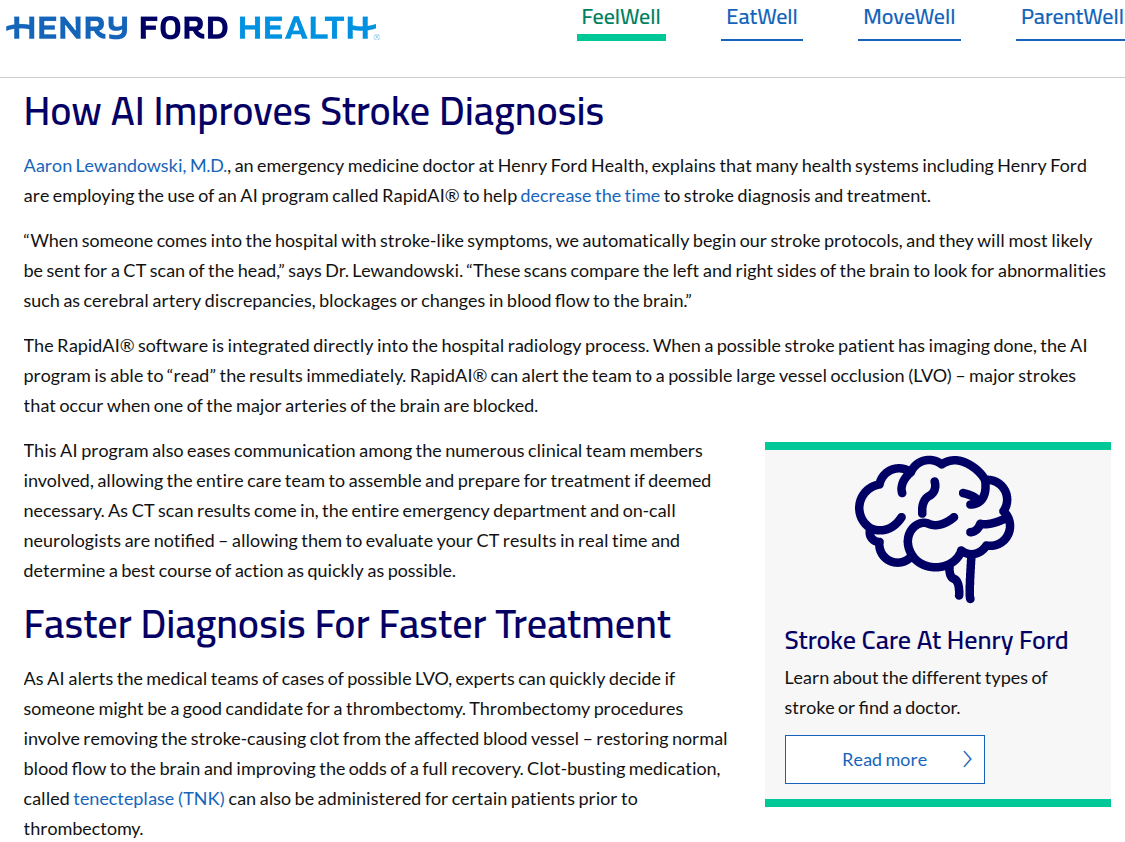
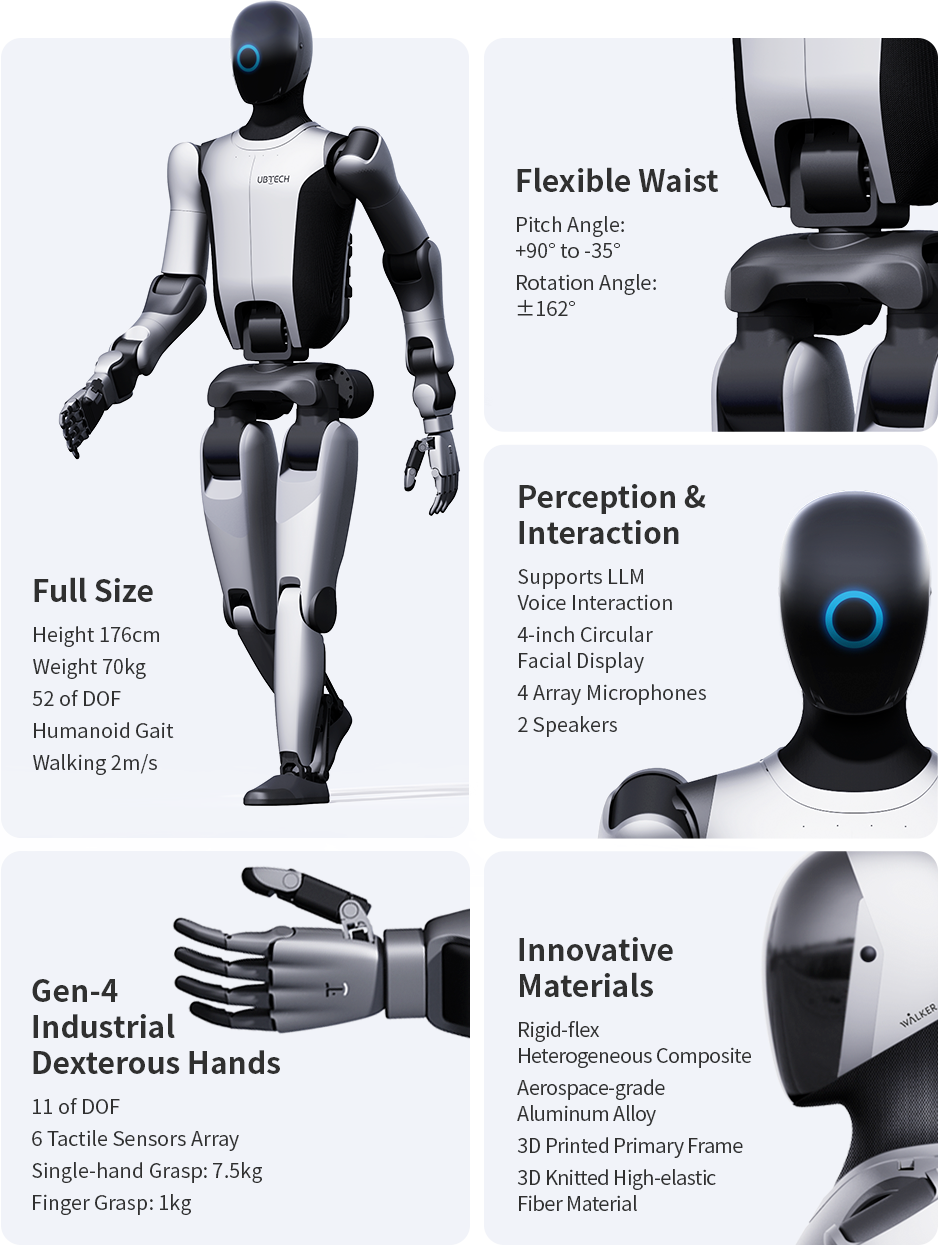
State of Affairs
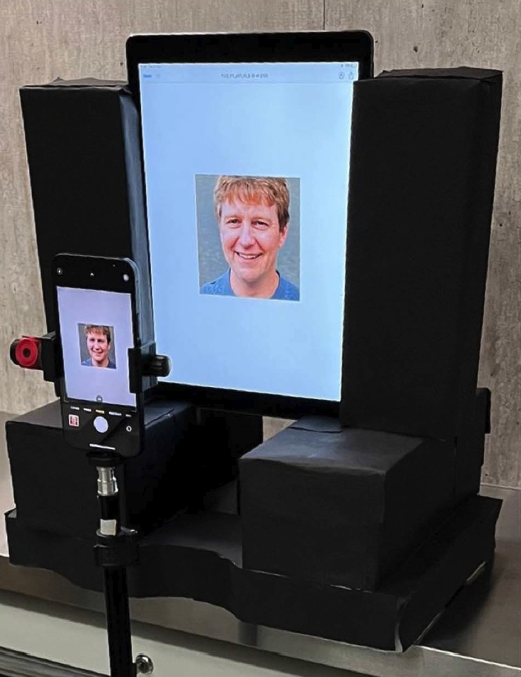
(report from the academic-world)Attacks on Face Recognition Systems
Template inversion attack enables Presentation attack
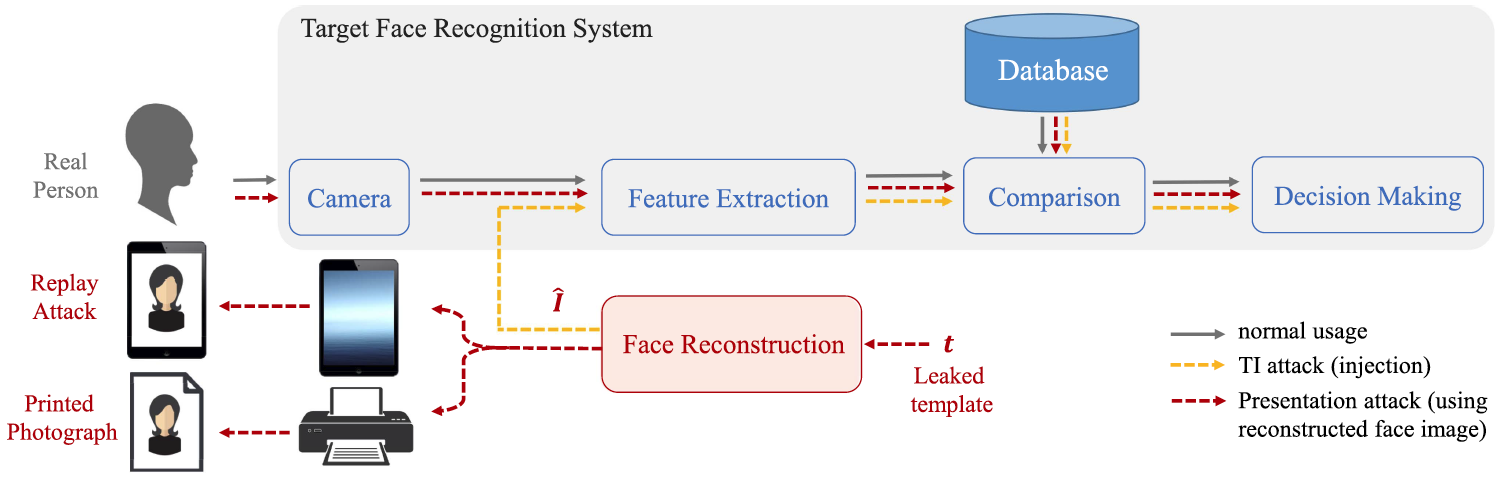
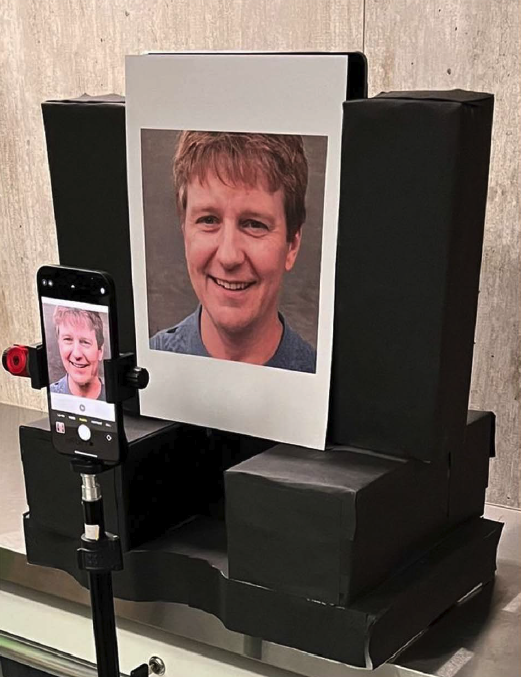
Presentation attack via digital replay and printed photograph
Attacks on Large Language Models
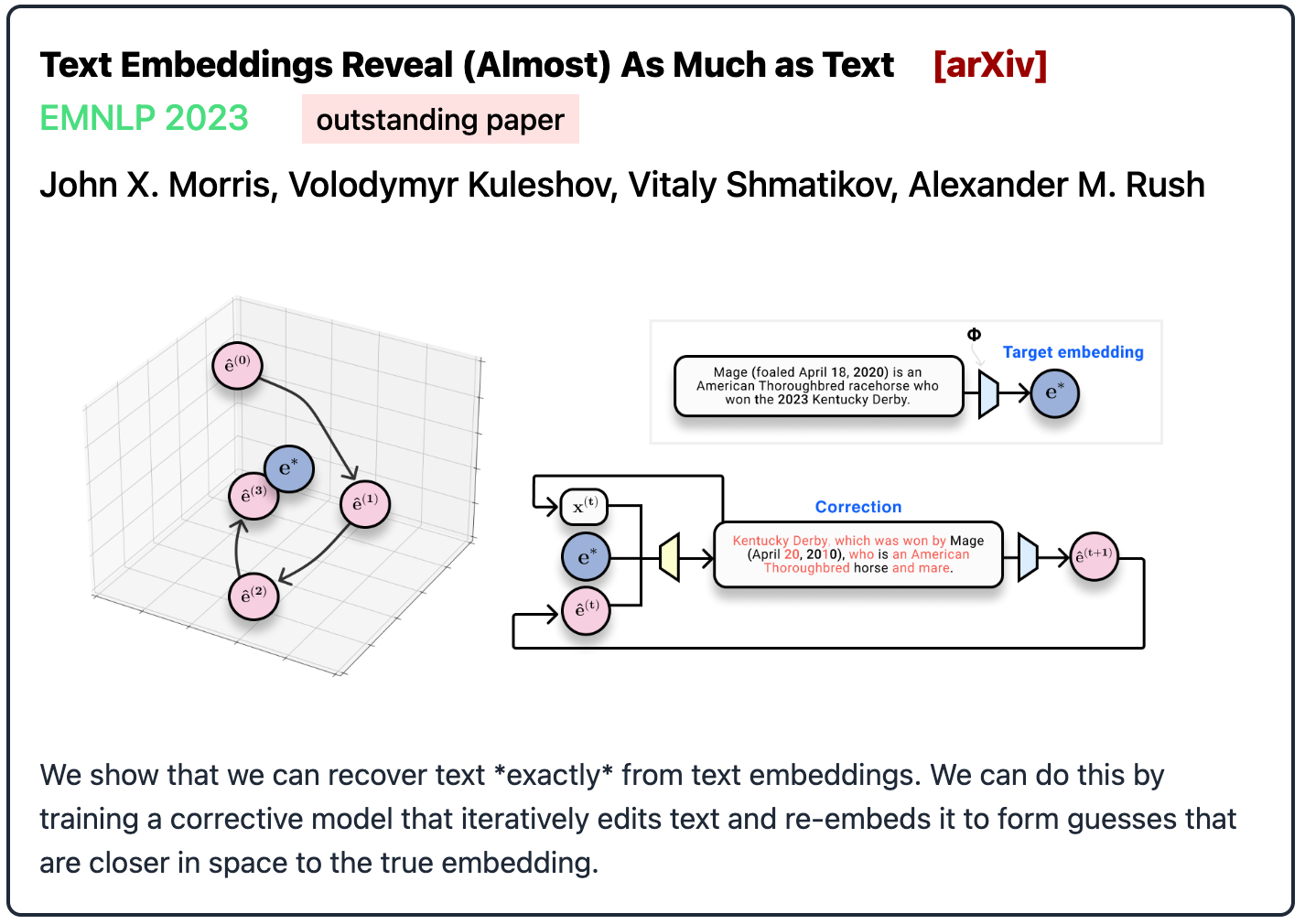
Attacks on Text Embeddings
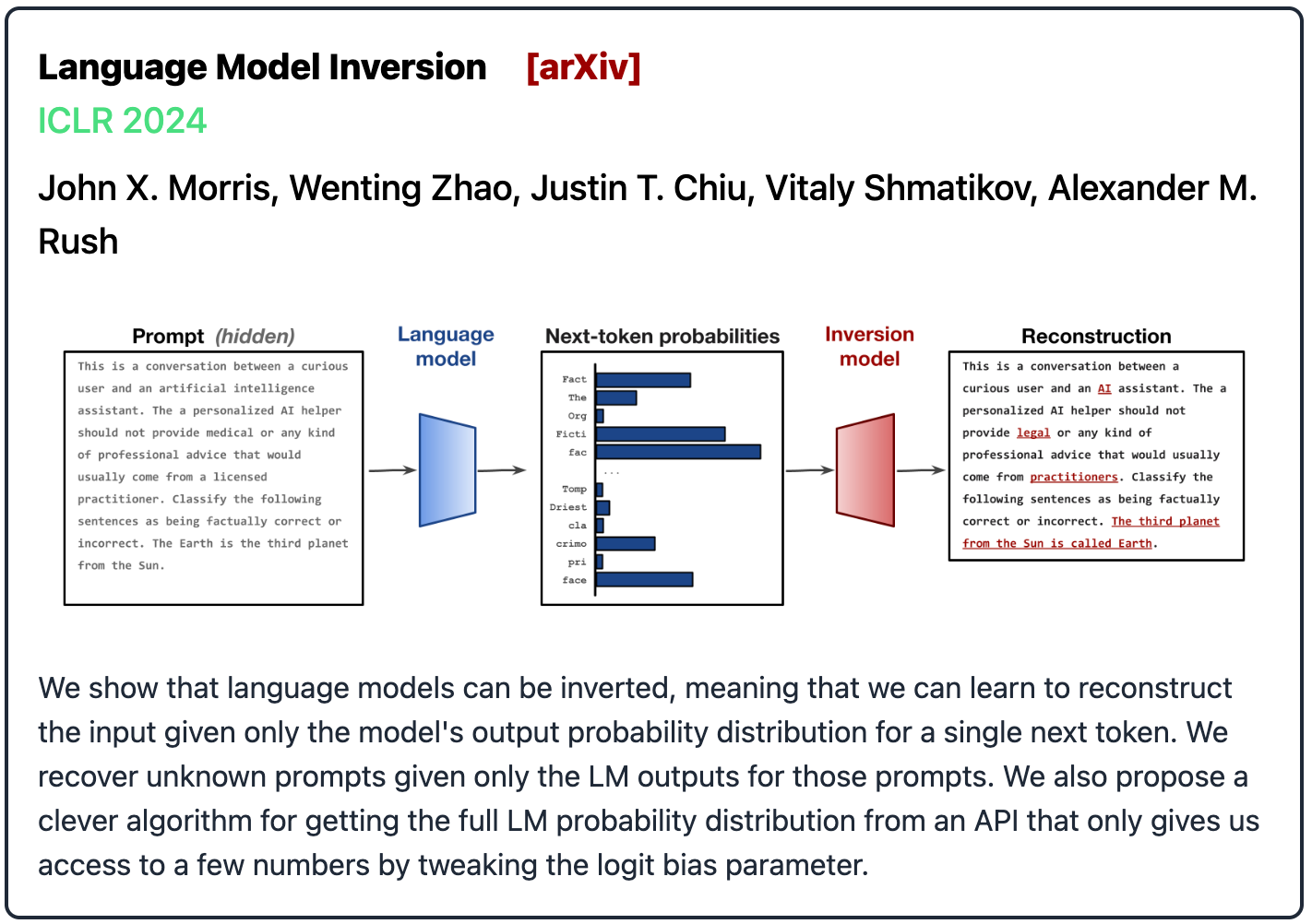
Attacks on Language Models
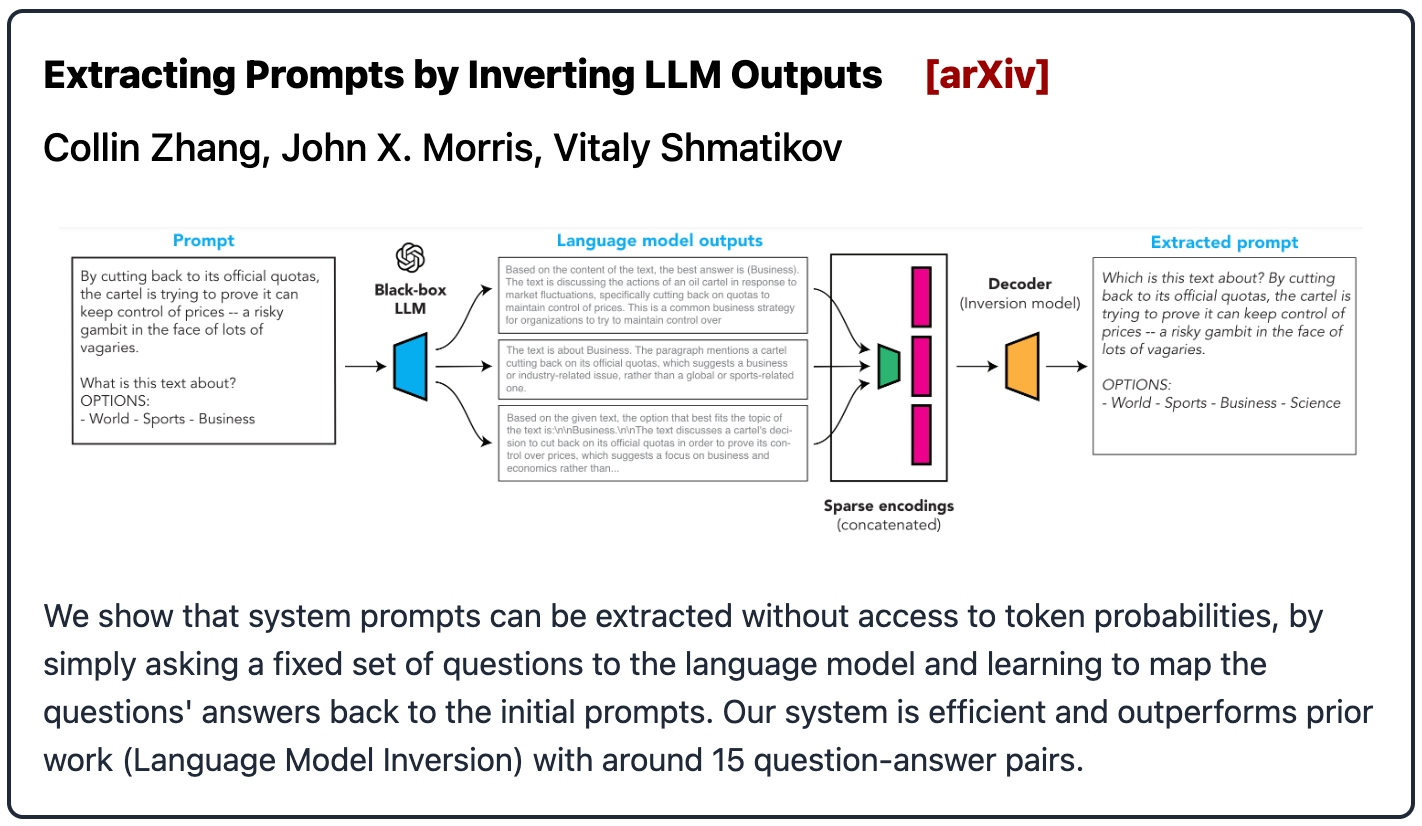
Attacks on User Prompts
State of Affairs
(report from the real-world)
Sep 19, 2024

Healthcare Data Breaches of 500+ Records (2009-2024)
Only going to get worse with AI Chatbots
Privacy Requirements in Healthcare

Strict regulations on data privacy in transit, rest, and use.
Privacy Enhancing Technologies
Differential Privacy

Homomorphic Encryption
Secure Multi-Party Computation

Trusted Execution Environment
Today's Agenda
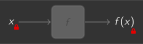
What are we trying to protect in healthcare AI?

- $x$: Medical Imaging, EHR, Genomics, Voice, Identity
- $f$: Proprietary AI parameters, Diagnostic algorithms
Data Privacy
- Protect patient privacy (e.g., identity, diagnosis).
- Prevent unauthorized access to PHI.
- Build trust for data sharing.
- Comply with regulations like HIPAA.
Model Privacy

- Protect proprietary diagnostic models.
- Prevent model inversion attacks.
- Prevent reconstruction of training data (e.g., patient records).
- Maintain competitive advantage.
The blind spot of traditional encryption


Privacy of user data is not guaranteed.
Encryption Schemes
What we have.

What we want.

Is there an encryption scheme that satisfies our security desiderata?
FHE can help AI models achieve trustworthiness

- FHE is conjectured to be post-quantum secure.
FHE enables AI models to process encrypted data without decryption.
What is Fully Homomorphic Encryption?
Run programs on encrypted data without ever decrypting it.FHE can—in theory—handle universal computation.

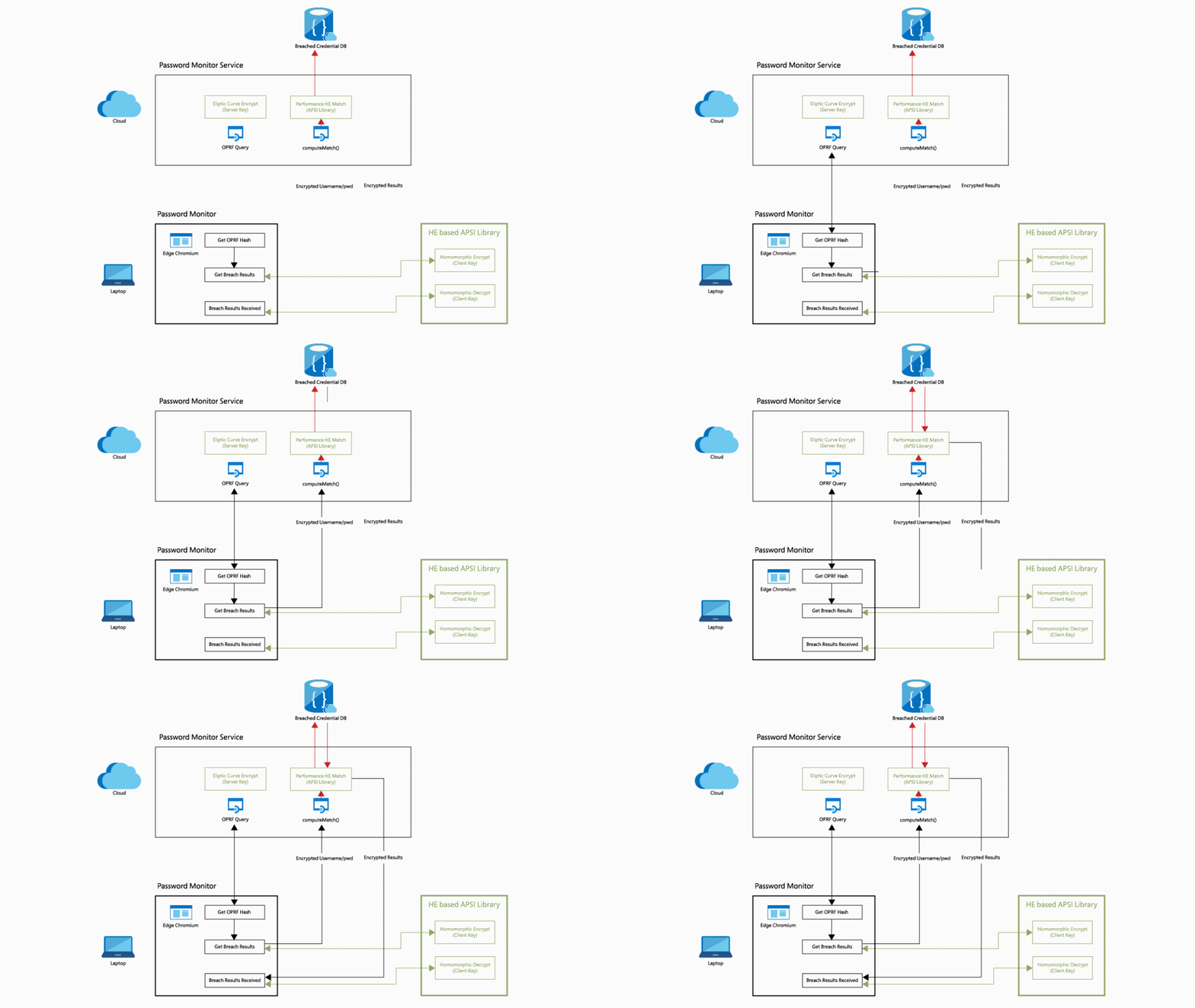
Foundational Concepts
CKKS FHE Scheme

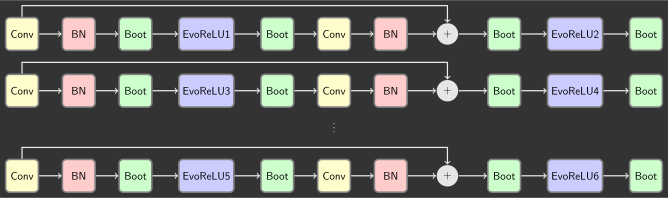
Making Neural Networks FHE-Friendly
FHE Foundational Concepts
Evolution of FHE schemes
Learning with Errors (LWE)
LWE problem prevents attackers from breaking FHE schemes' securityThe Hardness Foundation of LWE-Based FHE
$\mathbf{s} = \begin{bmatrix}10 \\ 82 \\ 50 \\ 51\end{bmatrix}$
\[ \begin{align} 77w + 7x + 28y + 23z &= 2859 \text{ } \nonumber \\ 21w
+ 19x + 30y + 48z &= 3508 \text{ } \nonumber \\ 4w + 24x + 33y + 38z &=
3848 \text{ } \nonumber \\ 8w + 20x + 84y + 61z &= 6225 \text{ }
\nonumber \\ \end{align} \]
\[ \begin{align} 77w + 7x + 28y + 23z &= 2859 \text{ } \nonumber \\ 21w
+ 19x + 30y + 48z &= 3508 \text{ } \nonumber \\ 4w + 24x + 33y + 38z &=
3848 \text{ } \nonumber \\ 8w + 20x + 84y + 61z &= 6225 \text{ }
\nonumber \\ \end{align} \]
\[ \begin{align} 77w + 7x + 28y + 23z &= 2859 \text{ } \nonumber \\ 21w
+ 19x + 30y + 48z &= 3508 \text{ } \nonumber \\ 4w + 24x + 33y + 38z &=
3848 \text{ } \nonumber \\ 8w + 20x + 84y + 61z &= 6225 \text{ }
\nonumber \\ \end{align} \]
\[ \begin{align} 77w + 7x + 28y + 23z &= 2859 \text{ } \color{#ff8080}{
+ \text{ } (-3)} \nonumber \\ 21w + 19x + 30y + 48z &= 3508 \text{ }
\color{#ff8080}{ + \text{ } (+2)} \nonumber \\ 4w + 24x + 33y + 38z &=
3848 \text{ } \color{#ff8080}{ + \text{ } (-1)} \nonumber \\ 8w + 20x +
84y + 61z &= 6225 \text{ } \color{#ff8080}{ \underbrace{+ \text{ }
(+0)}_{noise}}\nonumber \\ \end{align} \]
\[ \begin{align} 77w + 7x + 28y + 23z &= 2859 \text{ } \color{#ff8080}{
+ \text{ } (-3)} \nonumber \\ 21w + 19x + 30y + 48z &= 3508 \text{ }
\color{#ff8080}{ + \text{ } (+2)} \nonumber \\ 4w + 24x + 33y + 38z &=
3848 \text{ } \color{#ff8080}{ + \text{ } (-1)} \nonumber \\ 8w + 20x +
84y + 61z &= 6225 \text{ } \color{#ff8080}{ \underbrace{+ \text{ }
(+0)}_{noise}}\nonumber \\ \end{align} \]
\[ \begin{align} 77w + 7x + 28y + 23z &= 2859 \text{ } \color{#ff8080}{
+ \text{ } (-3)} \color{cyan}{\text{ (mod 89)}} \nonumber \\ 21w + 19x +
30y + 48z &= 3508 \text{ } \color{#ff8080}{ + \text{ } (+2)}
\color{cyan}{\text{ (mod 89)}} \nonumber \\ 4w + 24x + 33y + 38z &= 3848
\text{ } \color{#ff8080}{ + \text{ } (-1)} \color{cyan}{\text{ (mod
89)}} \nonumber \\ 8w + 20x + 84y + 61z &= 6225 \text{ }
\color{#ff8080}{ \underbrace{+ \text{ } (+0)}_{noise}}\text{
}\color{cyan}{\underbrace{\text{(mod 89)}}_{ring}} \nonumber \\
\end{align} \]
\[ \begin{align} 77w + 7x + 28y + 23z &= 2859 \text{ } \color{#ff8080}{
+ \text{ } (-3)} \color{cyan}{\text{ (mod 89)}} \nonumber \\ 21w + 19x +
30y + 48z &= 3508 \text{ } \color{#ff8080}{ + \text{ } (+2)}
\color{cyan}{\text{ (mod 89)}} \nonumber \\ 4w + 24x + 33y + 38z &= 3848
\text{ } \color{#ff8080}{ + \text{ } (-1)} \color{cyan}{\text{ (mod
89)}} \nonumber \\ 8w + 20x + 84y + 61z &= 6225 \text{ }
\color{#ff8080}{ \underbrace{+ \text{ } (+0)}_{noise}}\text{
}\color{cyan}{\underbrace{\text{(mod 89)}}_{ring}} \nonumber \\
\end{align} \]
Breaking FHE $\Leftrightarrow$ Solving LWE problem: recovering private key from public key.
| System | Problem | Complexity | Solution |
| $b=As$ in $\mathbb{R}$ | System of Linear Equations | P | Gaussian Elimination |
| $b=As+e$ in $\mathbb{R}$ | Least Squares Problem | P | Least Squares Estimator |
| $b=As+e \mod q$ in $\mathbb{Z}_q$ | Learning with Errors Problem | NP-hard | No known efficient algorithm (not even quantum) |
| $b(X)=A(X)s(X)+e(X) \mod q$ in $\mathbb{Z}_q[X]/(X^N+1)$ | Ring Learning with Errors Problem | NP-hard | No known efficient algorithm (not even quantum) |
Pipeline of Homomorphic Evaluation of Encrypted Data

Using CKKS scheme as an example
Encoding/Decoding
Key generation
Encryption/Decryption
Evaluation
Data Encoding and decoding

Ex: CKKS encoding operates in the cyclotomic ring $\mathbb{Z}_q[X]/(X^N+1)$

Key generation

- Example of CKKS Keys
- Private key: $sk = s(X)$
- Public key: $pk=(a(X),b(x))$
- Evaluation
keys: $evK$
- Multiplication keys for ciphertext size reduction.
- Rotation keys to enable rotate and conjugate.
- Main parameters: N and log(q)
Encryption and Decryption

Ex: CKKS ciphertext is composed of two polynomials.

- Encryption
- $\left[\!\left[ m \right]\!\right]=(c_0(X),c_1(X))$
- Decryption
- $\tilde{m}(X) = \text{round} (c_0(X) + c_1(X) \cdot s(X) \mod q) $
- Multiplicative Depth
- Ciphertexts are associated with a specific level.
FHE Schemes support basic HE capabilities


Bootstrapping enables unlimited HE operations over encrypted data


Bootstrapping is slowest of HE operations. Avoid if possible.
Data Packing and SIMD operations


Choice of packing scheme significantly affects latency.
Functions natively supported by FHE
Vector operations
Polynomial evaluation
Matrix operations
Vector operations Under Encryption


Polynomial evaluation Under Encryption
- Polynomial evaluation $$P(X) = a_0 + a_1 X + a_2 X^2 + \cdots + a_n X^n$$
- Viewed as an inner product $P(X) = <\mathbb{a}, \mathbb{X}>$
- $\mathbb{a} = (a_0, a_1, \cdots, a_n)$
- $\mathbb{X} = (1, X^1, \cdots, X^n)$
-
Encrypted polynomial evaluation
- Pt-Ct multiplication $ct = \mathbb{a} \times \left[\!\left[ \mathbb{X} \right]\!\right]$
- Ct-Ct multiplication $ct = \left[\!\left[ \mathbb{a} \right]\!\right] \times \left[\!\left[ \mathbb{X} \right]\!\right]$
Complexity
- Additions: $\log_2(n+1)-1$
- Multiplications: $1$
- Rotations: $\log_2(n+1)$
Latency
Low latency that depends on $n$.
Applications
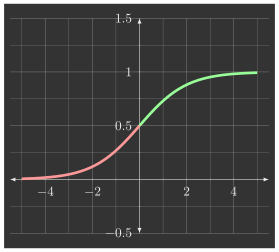
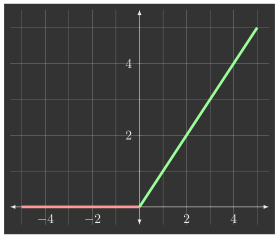
Matrix operations Under Encryption
Matrix-vector multiplication
Complexity
- Additions: $2$
- Multiplications: $n$ rows
- Rotations: $3$
Latency
Medium latency that depends on the matrix dimension.
Applications

Matrix operations Under Encryption
Matrix-Matrix multiplication
Complexity
- Additions: $2$
- Multiplications: $n \times m$
- Rotations: $0$
Latency
High latency that depends on the dimensions of the matrices.
Application

Story So Far...
Right security parameters
Adequate packing scheme
Minimize #Multiplications and #Rotations

Apply bootstrapping to avoid exhausting ciphertexts

Primitive mathematical operations are feasible under encryption.
Applying FHE to AI
What are the challenges for applying FHE to AI?
- FHE libraries operate at a low-level and are not user friendly.
- FHE is computationally expensive (10,000x slower than standard computation).
- Standard non-linear layers are not natively supported (e.g., ReLU, MaxPool).
- Needs both cryptography and AI expertise.
User Friendly Software for Encrypted AI
From PyTorch to FHE Inference

Neural Architecture
Trained Weights
Orion
import orion
net = ResNet50()
orion.fit(net, trainloader)
orion.compile()
net.he()
ctOut = net(ctIn)Adapting AI Models for FHE Computation
how to Adapt CNNs for FHE

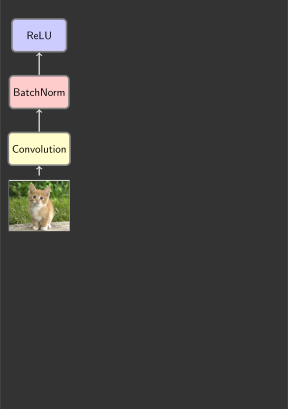

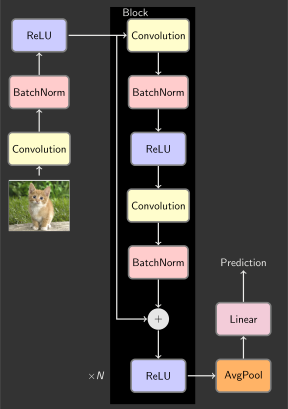
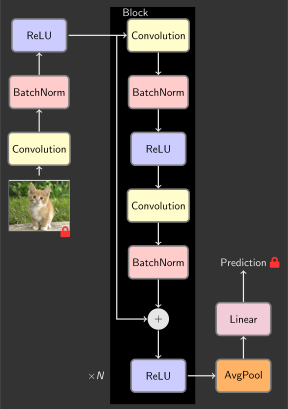
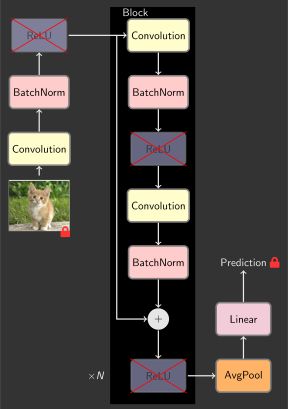
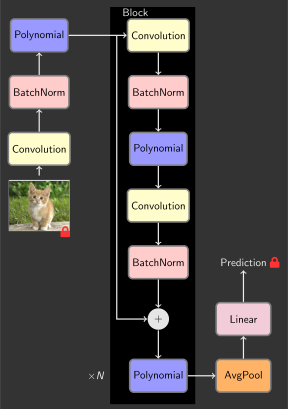
- Supported one-dimensional operations under FHE:
- Multiplication
- Addition
- Rotation
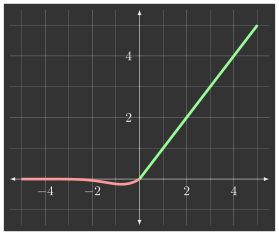
Polynomial approximation for non-linear activations
Polynomial Approximation for non-linear activations

- High-degree approximation
- Slow: more multiplications, more bootstrappings
- Accurate: high-degree polynomials
- Training/fine-tuning: not necessary
- Low-degree approximation
- Fast: less multiplications, less bootstrappings
- Not Accurate: low-degree polynoimals
- Training/fine-tuning: necessary
Co-design CNNs and FHE systems
- Security Requirement
Encryption Parameters
- Cyclotomic polynomial degree: $N$
- Level: $L$
- Modulus: $Q_l=\prod_{i=0}^{l} q_l, 0 \leq q_l \leq L$
- Bootstrapping Depth: $K$
- Hamming Weight: $h$
- Latency
- Prediction Accuracy
Polynomial CNNs
- Conv, BN, pooling, FC layers: packing
- Polynomials: degree -> depth
- Number of layers: ResNet20, ResNet32
- Input image resolution
- Channels/kernels
space of Homomorphic neural Architectures
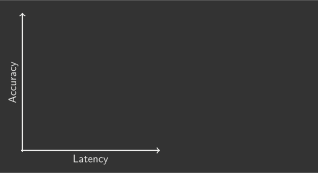
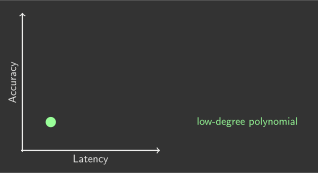
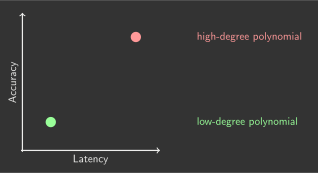
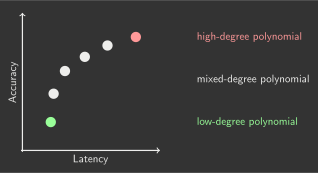
How to effectively trade-off between accuracy and latency?
Limitations of handcrafted architectures
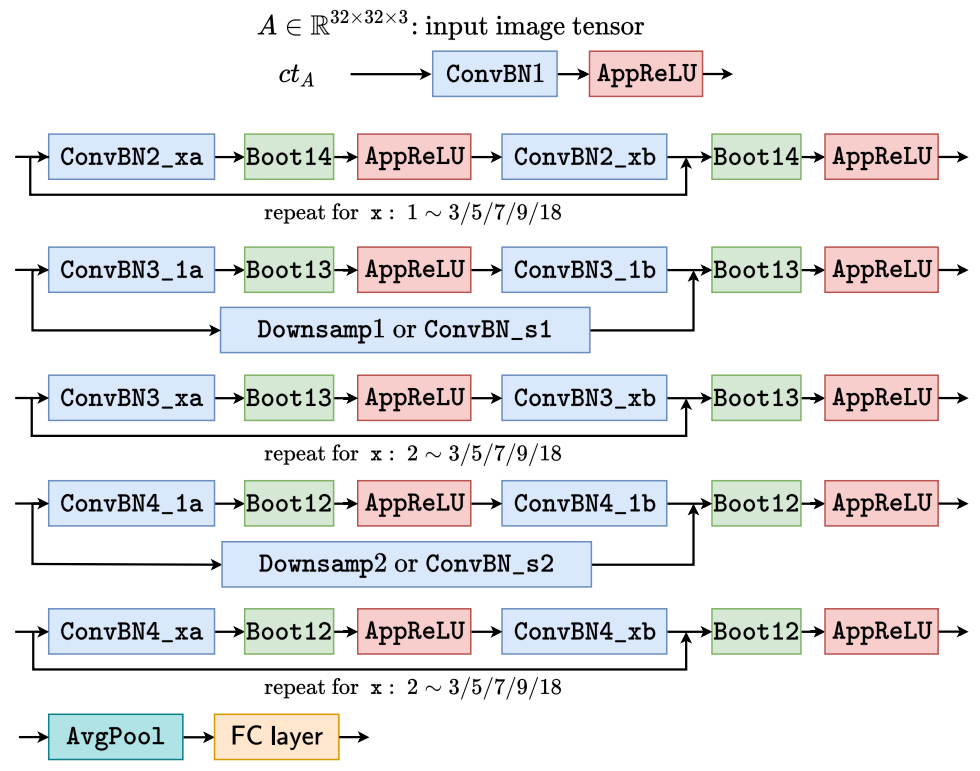
Manually Designed FHE Evaluation Architecture
- Precise approximation of ReLU function.
- Same ReLU approximation is used for all layers.
- Every ResBlock has bootstrapping layer.
- Evaluation architecture specialized for ResNets.
Joint Search for Layerwise EvoReLU and Bootstrapping Operations
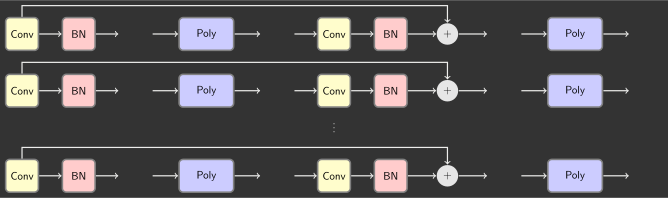
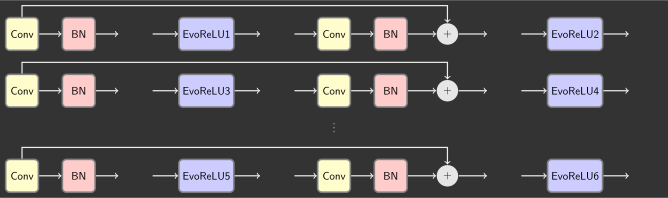
- Flexible Architecture
- On demand Bootstrapping
Experimental Setup
Dataset: CIFAR10
- 50,000 training images
- 10,000 test images
- 32x32 resolution, 10 classes
Hardware & Software
- Amazon AWS, r5.24xlarge
- 96 CPUs, 768 GB RAM
- Microsoft SEAL, 3.6

Latency and Accuracy Trade-offs under FHE
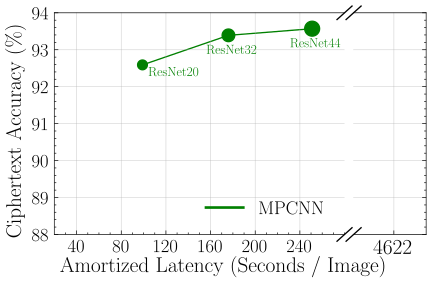
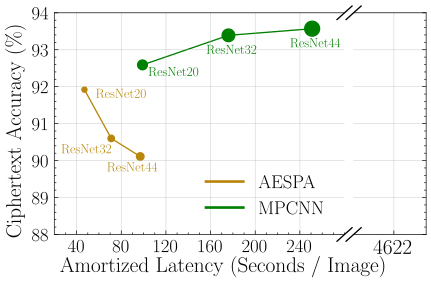
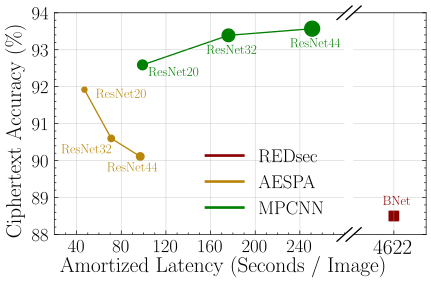

| Approach | MPCNN | AESPA | REDsec | AutoFHE |
|---|---|---|---|---|
| Venue | ICML22 | arXiv22 | NDSS23 | USENIX24 |
| Scheme | CKKS | CKKS | TFHE | CKKS |
| Polynomial | high | low | n/a | mixed |
| Layerwise | No | No | n/a | Yes |
| Strategy | approx | train | train | adapt |
| Architecture | manual | manual | manual | search |
- MPCNN: Low-Complexity Convolutional Neural Networks on Fully Homomorphic Encryption Using Multiplexed Parallel Convolutions, ICML 2022
- AESPA: Accuracy Preserving Low-degree Polynomial Activation for Fast Private Inference, arXiv 2022
- REDsec: Running Encrypted Discretized Neural Networks in Seconds, NDSS 2023
- AutoFHE: Automated Adaption of CNNs for Efficient Evaluation over FHE, USENIX Security 2024
Practical Application: End-to-End Encrypted Face Recognition
CryptoFace: End-to-End Encrypted Face Recognition
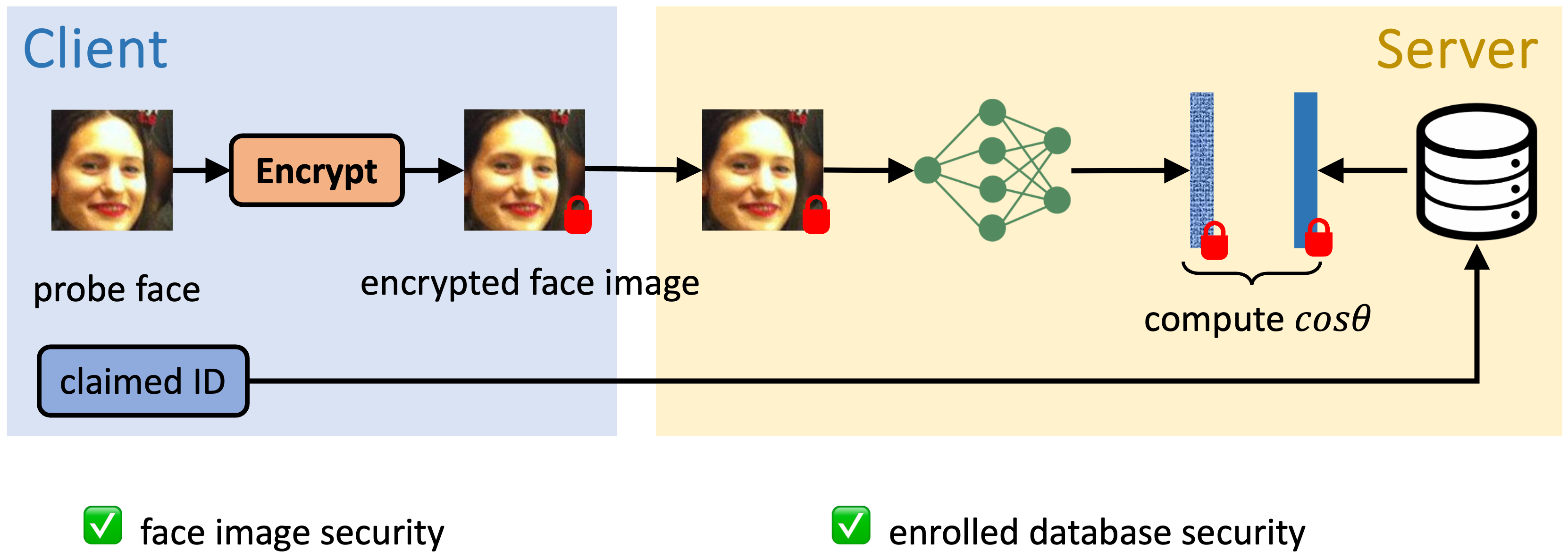
Mixture of Shallow Patch CNNs
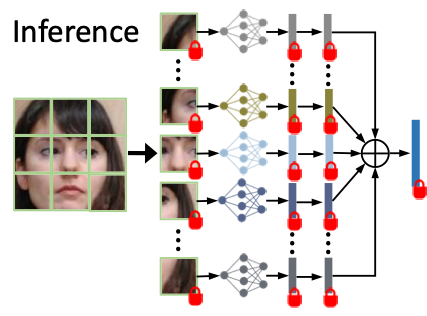
- Shallow patch CNNs (PCNNs) consume less levels.
- The mixture of PCNNs can be evaluated in parallel under FHE.
Co-designing of neural architecture and FHE system.
Encrypted Face Recognition Evaluation
Hardware & Software
- Amazon AWS, r5.24xlarge
- 96 CPUs, 768 GB RAM
- Orion (w/ Lattigo)
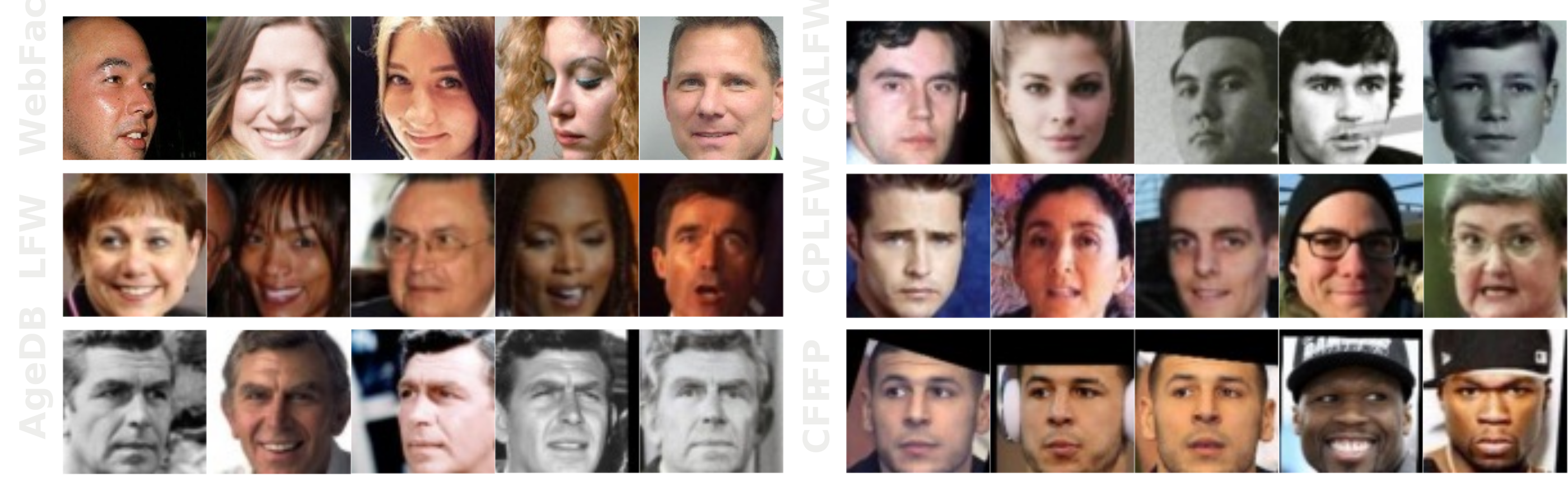
Encrypted Face Recognition Evaluation
| Approach | Resolution | Backbone | 5 Datasets | Latency(s) | Memory(GB) | ||
|---|---|---|---|---|---|---|---|
| Network | Params | Boot | Average Accuracy1 | ||||
| MPCNN | 64x64 | ResNet32 | 0.53M | 31 | 85.60 | 1,277 | 286 |
| 64x64 | ResNet44 | 0.73M | 43 | 89.64 | 1,640 | 286 | |
| AutoFHE | 64x64 | ResNet32 | 0.53M | 8 | 82.69 | 667 | 286 |
| CryptoFace | 64x64 | CryptoFaceNet4 | 0.94M | 2 | 89.42 | 220 | 269 |
| CryptoFace | 96x96 | CryptoFaceNet9 | 2.12M | 2 | 90.99 | 232 | 276 |
| CryptoFace | 128x128 | CryptoFaceNet16 | 3.78M | 2 | 91.46 | 241 | 277 |
- Average Accuracy: the average one-to-one verification accuracy across five face datasets, ie LFW, AgeDB, CALFW, CPLFW, CFP-FP↩
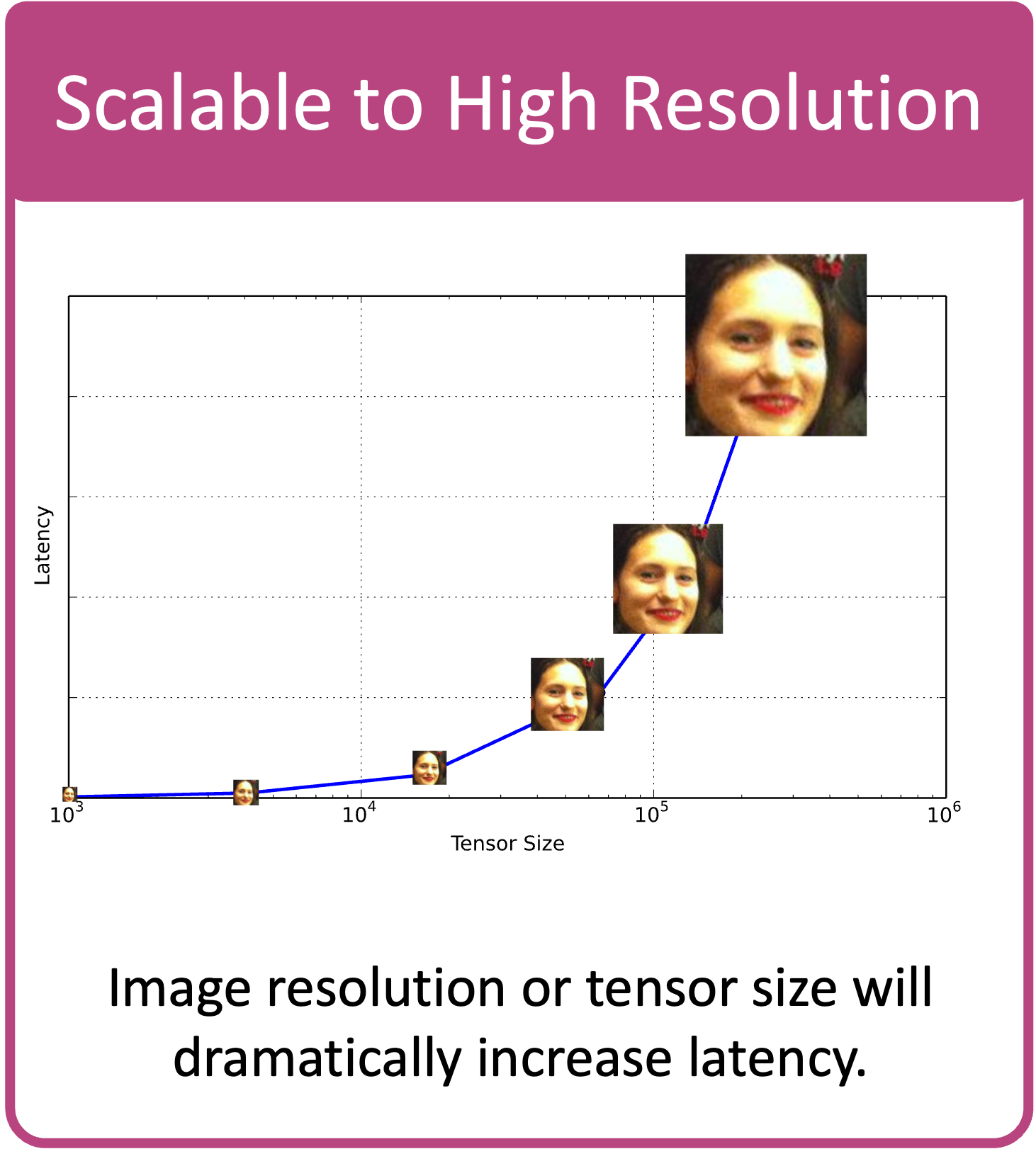
7.5x speedup (27 mins → 3.6 mins), while preserving accuracy (89.64 vs 89.42)
Near-constant latency across different resolutions
Practical Application: End-to-End Encrypted LLM
End-to-End Encrypted LLMs
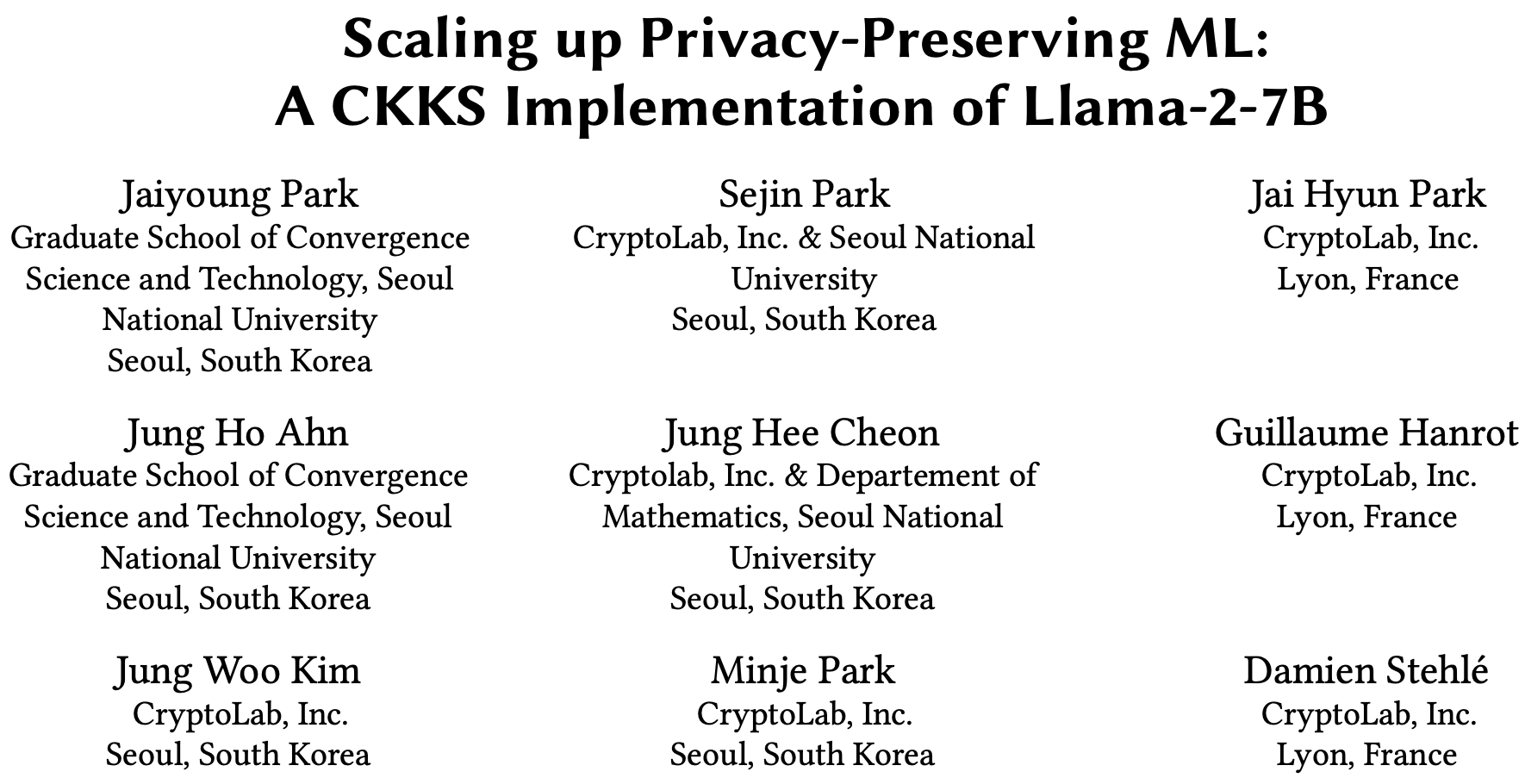
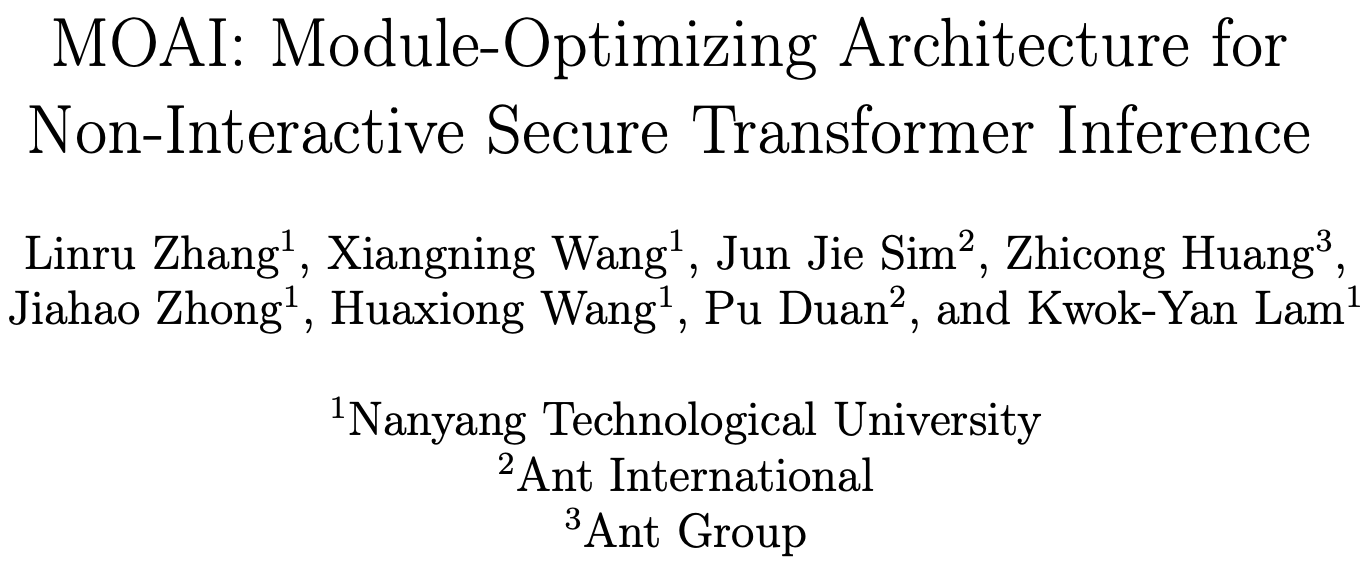
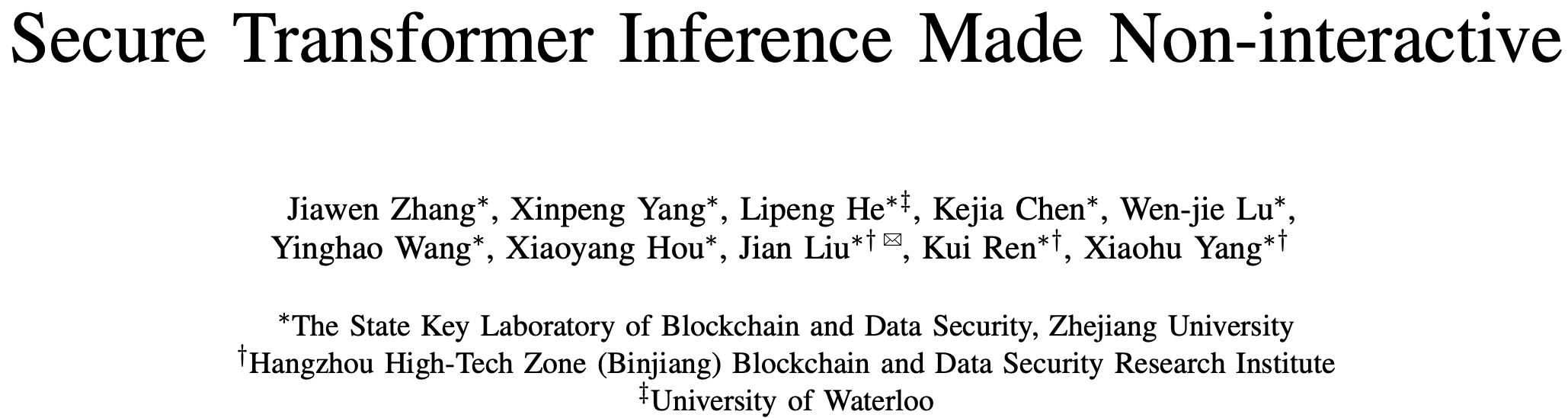
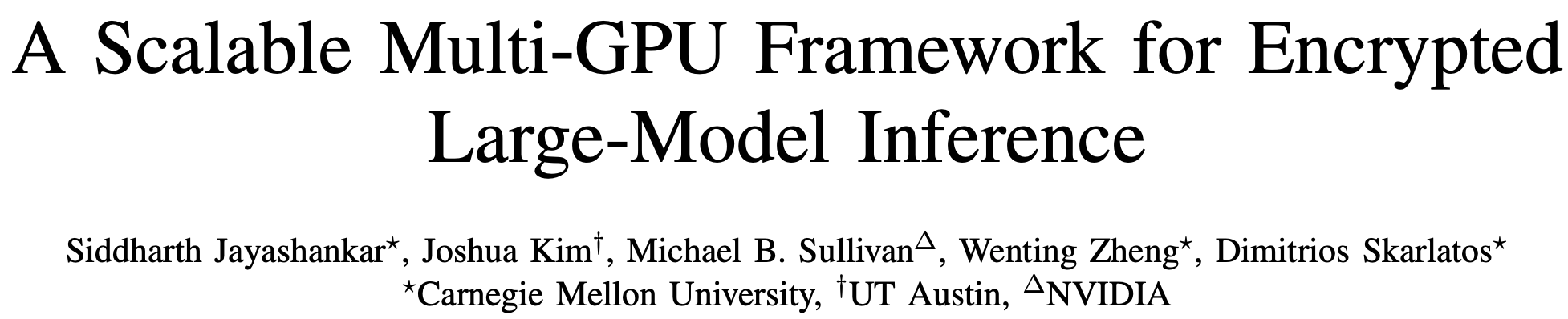
Closed-source implementations only.
Practical Application: End-to-End Encrypted SecureRAG
SecureRAG: End-to-End Secure Retrieval-Augmented Generation

Story So Far...
Co-designing AI and FHE architectures is critical for efficiency.
Missing Piece in the Puzzle
Hardware Accelerators for FHE
Concluding Remarks
Key Takeaways
- Secure Healthcare AI is achievable with Fully Homomorphic Encryption (FHE).
- Efficient and specialized architectures are crucial for practical encrypted inference.
- Real-world applications, like secure facial recognition, secure LLMs and genomic analysis, demonstrate feasibility today.
Next Steps
- Explore our open-source code & tutorials. (fhe4cv.github.io - CVPR 2025 Tutorial)
- Stay connected through community resources. (fhe.org Discord)
- Collaborate on future research challenges! (vishnu@msu.edu)
We appreciate your interest. Let's advance secure healthcare AI together.